Showing posts with label CITES license. Show all posts

Tuesday, May 8, 2012

Article Review: CIFOR Blog:: New timber tracking tools to bolster global fight against illegal logging

The post iss related to the new tracking method to curb illegal logging through tracing the species DNA that was discussed in the workshop held in Kuala Lumpur, Malaysia.  The studies using DNA market to identify timber species and analyze genetic variation in the forest has been carried out for more than ten years. This system is coherent with the existing  EU FLEGT requirement and Lacey Act that has been debating to minimize the risk of illegal logging timber products to enter EU and US market.

What is it about?
The Global Timber Tracking Network (GTTN) promotes the use of innovative control tools based on the application of DNA and stable isotope research to identify timber species and trace their origins. The Global Timber Tracking Network aims to create a global database featuring genetic and stable isotope markers for commonly traded timber species, a landmark tool designed to reinforce certification standards and legislation and to complement existing paper-based documentation that can be easily falsified. 

How does it work?
Through the DNA and stable isotope markers as the legit information (as indicator in the assessor checklist) enter into the database, where is also accessible to the importers. This  enables to importers to verify the precise species and origin of wood and wood products and provide tangible proof that the products were genuinely derived from a sustainably managed forest or other legally harvested timber.  


How would the wood sample be?
To create the database shall require integrating data generated by different research techniques and that has been collected by scientist working in various location around the world. 


What are the equipment use to test the wood sample, what are the total sample need to quantify and how long does it takes?  
A global standard (i.e.: similar FSC standard) for sampling and lab analysis of genetic and stable isotope data shall be establish in order to ensure the technique used to gather and analyze the data are repeatable and verifiable. 


Any successful pilot project? 
To date, just a handful of projects have created individual databases for certain timber species. 

Malaysia
The Forest Research Institute of Malaysia (FRIM) established an early database of tropical timber species using DNA fingerprinting data. The FRIM database has genetic data for:
  1. chengal (Neobalanocarpus heimii) -IUCN Red List
  2. ramin (Gonystylus bancanus) -IUCN Red List
  3. kempas (Koompassia malaccensis) (Traded Timber Species) (WIP) and 
  4. meranti bukit (Shorea platyclados)  (Traded Timber Species) (WIP)
Currently, the GTTN database shall be test whether the data generated by analyses of wood samples match the stated species and origin on the product label.

Africa
Double Helix will design and implement DNA Chain-of-Custody systems for several supply chains. To achieve this we are actively working with government partners, concession owners/managers and community groups. The project will create DNA barcodes for twenty important African timber species and will generate a map of genetic variation across the different participating countries for three commercial tree species: Ayou (Triplochiton scleroxylon), Iroko (Milicia sp.) and Sapele (Entandrophragma cylindricum). By the end of the project, the trade and Governments will have the ability to verify the species and origin of harvest of these timber species. It will provide a scientific, cost-effective method to verify claims and other supply chain documentation, enforce legislation and exclude illegally harvested timber from being laundered through legitimate supply chains. The genetic reference databases will be held by Bioversity International in Malaysia, the international coordination office for tree identification and origin assignment. Below are the countries covered under this project.
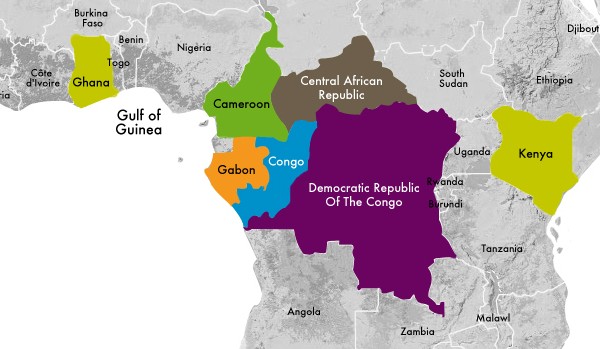
What are the major challenges or obstacle?
In Brazil, a key timber-producing nation believed to have the world’s greatest biodiversity of plant species, correctly identifying timber species is especially challenging, said Milton Kanashiro, a research geneticist at the Brazilian Agricultural Research Corporation (EMBRAPA). “Identifying species is a big problem in Brazil. Different species of trees often end up getting classified under one species because it can be difficult to properly identify so many species in the field,” Kanashiro said. “If species are not identified, we could be losing biodiversity without knowing it. And if you don’t know you are losing a species, you cannot properly protect it.”
My opinion of the major challenges for DNA Timber Tracking:
  1. Reaching agreement on standards may be the most difficult aspect of making the timber tracking system operational.
  2. The research takes time, have not fully define total isotopes needed for isotope marking
  3. At present only covers endanger species, and several tree species have overlaps of isotopes marker.
  4. Questionable about the type of equipment needed for the importer or the require knowledge by the importer to ensure they understand the system and also does not take a very long time to verify the legality of the timber in the port.

Thursday, April 26, 2012

Article Review: EU “Timber” Regulation (Regulation (EU) No 995/2010)

A short review about EU Timber Regulation base on this post.

What is EU "Timber" Regulation?
In October 2010 the EU adopted a new Timber Regulation  to combat trade in illegally harvested timber. This is one of a number of actions under the 2003 EU Action Plan on Forest Law Enforcement Governance and Trade (FLEGT).

Why EU 'Timber" Regulation?
Spurred by discussions at the East Asia FLEG conference in September 2001, the European Commission published its Action Plan on Forest Law Enforcement, Governance and Trade (FLEGT) in May 2003. Approved by the Council of the EU in October 2003, it included the following proposals:
  • Negotiation of bilateral FLEGT voluntary partnership agreements (VPAs) with producer countries. The VPAs will feature a licensing system designed to identify legal products exported from partner countries and license them for import to the EU; unlicensed products will be denied entry. (See Voluntary Partnership Agreements page.)
  • Capacity-building assistance to partner countries to set up the licensing scheme, improve enforcement and, where necessary, reform their laws.
  • Examination of EU member states' existing domestic legislation, and consideration of additional legislative options, to prohibit the import of illegal timber. (See EU FLEGT: Timber Regulation.)
  • Encouragement for the use of government procurement policy to limit purchases to legal (and sustainable) sources. (See Public Procurement page.)
  • Encouragement for voluntary industry initiatives to control their own supply chains, and thereby exclude illegal products. (See Supply Chain Management page.)
  • Encouragement for financial institutions to scrutinise flows of finance to the forestry industry. (See Banks and Finance page.) 
A key element of the FLEGT Action Plan is a voluntary scheme to ensure that only legally harvested timber is imported into the EU from countries agreeing to take part in this scheme. The internal EU legal framework for this scheme is a Regulation adopted in December 2005, and a 2008 Implementing Regulation, allowing for the control of the entry of timber to the EU from countries entering into bilateral FLEGT Voluntary Partnership Agreements (VPA) with the EU.  Once agreed, the VPAs will include commitments and action from both parties to halt trade in illegal timber, notably with a license scheme to verify the legality of timber exported to the EU. The agreements also promote better enforcement of forest law and promote an inclusive approach involving civil society and the private sector.

How to implement and what is the obligation?
1. Due Diligence- "operators" shall use procedures and measures called "due diligence system" (DDS)
The core of the ‘due diligence’ notion is that operators have to undertake a risk management exercise so as to minimize the risk of placing illegally harvested timber, or timber products containing illegally harvested timber, on the EU market.
The three key elements of the “due diligence system” are:
  • Information: The operator must have access to information describing the timber and timber products, country of harvest, quantity, details of the supplier and information on compliance with national legislation.
  • Risk assessment: The operator should assess the risk of illegal timber in his supply chain, based on the information identified above and taking into account criteria set out in the regulation.
  • Risk mitigation: When the assessment shows that there is a risk of illegal timber in the supply chain that risk can be mitigated by requiring additional information and verification from his supplier
  
Source of the picture above: FLEGT June 2012 capacity4dev
 
2. Prohibition to place illegally harvested timber or timber products on the EU market
Through Timber Legality Assurance System (TLAS) of each own country. Source the timber back to the forest license area.
3. Traceability -"Traders" shall be identified to their suppliers and customer
Through the central point of expertise for timber procurement website provides online information on how to meet the UK Government’s Timber Procurement Policy, the EU Timber Regulation and the Forest Law Enforcement Governance and Trade (FLEGT) Regulation.


What is the product scope?
Listed in Annex using EU Custom codes. Covers a wide range of timber products (solid wood products, flooring, plywood, pulp) and includes  printed papers such as books, magazines and newspapers. The product scope can be amended if necessary. The Regulation applies to both imported and domestically produced timber and timber products. Timber and timber products covered by valid FLEGT or CITES licenses are considered to comply with the requirements of the Regulation. 


Does not cover waste and recycled products, packaging material to support or carry another product, certain bamboo and rattan products or other products not listed in Annex (e.g.: toys, musical instruments). Maybe amended to include other products

What is illegally harvested timber?
Harvested in contravention of the applicable legislation in the country of harvest such  as 
    1. Legal rights to harvest
    2. Taxes and fees linked to harvesting
    3. Compliance with timber harvesting laws, including directly related environmental and forest legislation
    4. Respect for third parties tenure/use rights
    5. Relevant trade and customs rules
Who is liable?
“Operators” = any natural or legal person who places timber or timber products on the EU market.  Liable for exercising of due diligence and prohibition
"Traders” = any natural or legal person who trades on the internal market timber or timber products already placed on the market. Liable for the “traceability

Who checks? Role of the member state 
Competent authorities =national government bodies responsible for the application and enforcement. This means looking into operators, monitoring organizations (selected from 27 EU member states)  and reports.  List of CA can be found here.  Penalties: effective, proportionate and dissuasive penalties
 
How does FLEGT and CITES licenses work?
Products covered by FLEGT or CITES licenses are considered to have been legally harvested for the purposed of the EU Timber Regulation. Means by importing FLEGT or CITES licenses timber, due diligence is exercised.

How about 3rd party verification?
Does not enjoy the "green lane" as FLEGT or CITES license. May be taken into account in the risk assessment and risk mitigation procedures if cover compliance with applicable legislation and if considered credible. Criteria for assessing their credibility in the implementing regulation.

When will EU Timber Regulation take place?
3rd of March 2013

April / June 2012 a delegated Regulation on the procedural rules for the recognition and withdrawal of recognition of monitoring organization (selected from 27 EU member states)

June 2012 an implementing Regulation on the detailed rules concerning the due diligence system, the frequency and nature of the checks on monitoring organizations.